The idea behind installing a radon system during the building phase is to save money. Building a home radon proof is also easier than retrofitting a new home with a radon system. Companies that I work with or have worked with that use RRNC (radon-resistant new construction) practices include: The Snyder Companies, Tony Ciufo Inc and Royal Design & Construction Inc.
What RRNC consists of:
A base of crushed stone a minimum of 6- 8 inches is suggested, level out the stone inside the footers. *The crushed stone should be covered with plastic sheeting.
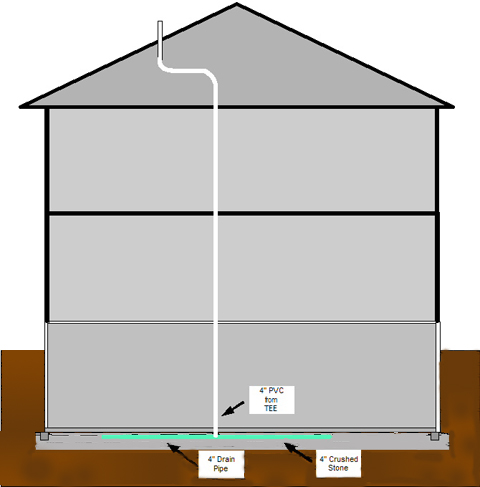
Install 2 lengths of 4" perforated pipe into the crushed stone below the plastic, bring the 2 pipes together in a TEE that will protrude from the slab. The TEE should be located as close to the center of the house as possible.
After the slab has been poured, it is time to install a passive system. Connect schedule 40 4" PVC pipe to the pipe in the slab. Route the pipe through the home to the attic or to another unconditioned space and vent it through the roof. The vent must be two feet above or ten feet away any windows and ten feet above the ground.
* Please consider that a passive system may need to converted to an active system, there should be adequate space to allow for a fan. An outlet that is on a breaker with other rooms will need to be installed within six feet (6') of where the a fan would be placed. *A dedicated outlet should not be used.
Any floor drains will need to have a one way drain, like a Dranjer. Cracks along the slab and foundation joints should be sealed with self-leveling concrete crack sealant. Any pipe entries for water or other service entries will need to be sealed using concrete crack sealant or Great Stuff Windows and Doors.
Below is a BASIC diagram showing a cut-away view of a passive radon system.